|
United States Colleges and Universities
Help for Student Victims of Hurricanes
- Introduction
- Understanding Re-entry Issues
1. Introduction
The reality is that returning home after a significant
experience is not without its stresses. It can become more difficult
when your family
and
friends have
also been away and had experiences of their own, and when home itself
has undergone significant change. It is important to recognize that
you may
have some stress
upon returning, even though it is your home. This is all apart of the
re-entry process. Understanding that this may happen will help you
prepare for these
feelings.
2. Understanding Re-entry Issues
(The following information has been adapted from the University of the
Pacific’s “What’s up with Culture” Module
2.3.1, developed by Professor Bruce LaBrack)
The experience of re-entry may happen because:
It is largely unexpected
Few people prepare for the return home because
they expect it to be easy and are surprised when it is not. You
may not expect it to be easy, but you may not
understand the ways in which it may be difficult, outside what you are expecting.
The reality of home has become very different
When you are away, images of home life can become blurred. Even though you
may think you know what to expect upon returning home post-Katrina, you may
not be
fully prepared for what home now means. It is easy to want to forget or minimize
the problems or issues that once were sources of stress in your everyday
life, or not want to deal with the new issues that will surround you at home.
This
becomes more difficult when you have become used to a different place and
lifestyle after being displaced.
Change has occurred to everyone
However major or subtle, things are different. You, the people around you,
your school, and your community have changed a great deal as a result of
Katrina. Sometimes these changes are obvious and immediately observable;
sometimes they
are "hidden" and only come out under certain circumstances-which
are usually unpredictable and therefore unsettling.
People may react to returnees in different ways
People generally expect you to be the same person you were when you left
and usually attempt to treat you that way. They may have little patience
for a
returnee who seems to be significantly "different" or who exhibits
behaviors or attitudes that, to them, seem odd or uncharacteristic of that
person. Remember
that people who remained at home have also changed in some respect after Katrina.
Re-entry may not be recognized nor understood at home
Few people at home are likely to be familiar with the concept of re-entry.
Therefore, people often respond to a returnee having difficulty readjusting
by bluntly suggesting
they "get over it" as though it were a conscious act on their part
or that they could control their emotions if they wanted to. Upon reentry the
pressure to conform quickly and substantially can be intense and tolerance
can be in short supply. It is important to keep in mind that everyone at home
has
changed whether they left home or not, and as a result there will be a period
of adjustment that everyone will experience.
Going home will not be easy, and will be at least as challenging and as frustrating
as living elsewhere after being displaced. Even though you realize that going
back will not be a simple matter of resuming your earlier routines and reestablishing
prior relationships, reentry has its own set of special social and psychological
adjustments as well. This is compounded by the fact that due to hurricane
Katrina your earlier routines and relationships are likely to have changed-your
campus
and town may look different and feel unfamiliar, people you knew well may
have moved from the area, you may be attending a different school or a different
version
of your own school.
Re-entry has definable phases.
The relief at being back is often present
for some period, followed by some degree of irritation and alienation, with
an eventual
readjustment.
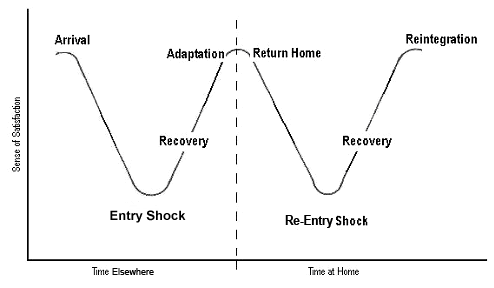
As the graph shows, the "U-shaped" adjustment curve that roughly illustrates
the adjustment to being away and re-entry shock can be modified to a "W," showing
the transition process through reentry. While the phases may be quite similar,
the timing and duration of them is not. For example, your positive feelings about
where you were studying might have lasted a matter of days or weeks (even months),
but at home the elation of return can dissolve rather quickly. Returnees can
find themselves slipping into deepening hostility or withdrawal in very short
time. The feelings that come with re-entry can take hold within hours of arriving
home. There are many contributing factors that might intensify and accelerate
the process during reentry, not the least of which is you and your family’s
situation post-Katrina.
You will undergo a period of adjustment upon your
return; to find out more about these adjustment issues,
please continue to the next exercise, Adjustment Issues.
|